Meeting Ines Yong: The Real Energy Behind Digital Assets
On April 28, 2026, I met Ines Yong, co-founder and CEO of GEN. The encounter brought my thinking about digital assets back to tangible equipment, day-to-day operations, and the people working together behind them.
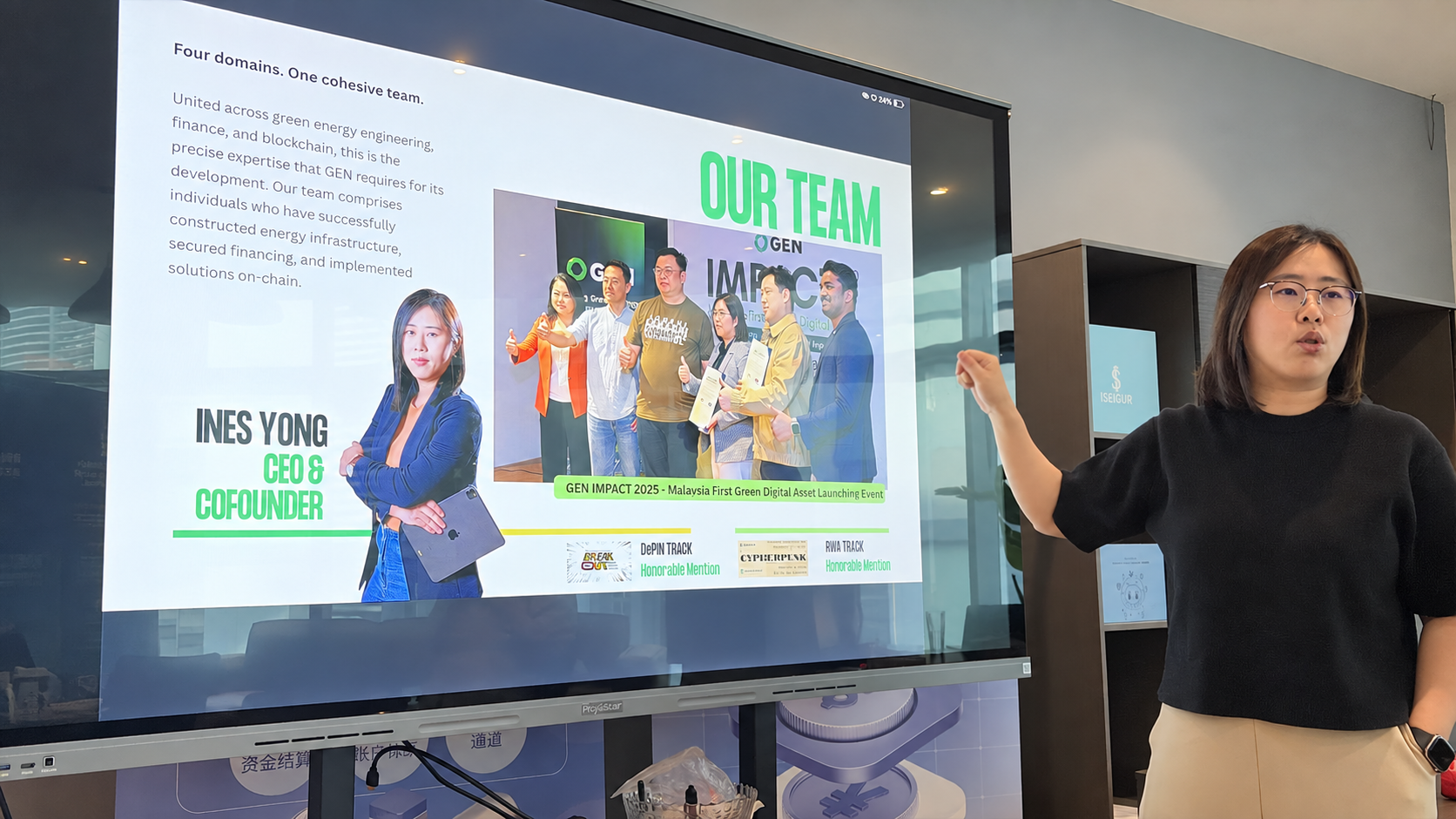
On April 28, 2026, I met Ines Yong of GEN. In the photograph, she is standing beside a presentation about the team, bringing together green energy, engineering, finance, and blockchain.
I wanted to keep this photograph, and a thought alongside it: when we talk about digital assets, it is easy to keep looking at the screen. Yet much of what supports them exists beyond it.
Looking beyond the screen
GEN stands for Green Energy Network. A report republished by Sina Finance on November 18, 2025 described its efforts to connect green energy infrastructure, energy data, and digital assets. It outlined an approach to collecting and verifying energy data, and identified Ines Yong as co-founder and CEO.
What interests me about this direction is how it brings an abstract subject back to a concrete process of production. Electricity has to be generated. Equipment needs maintenance. Data needs a source. Operations have to continue. No digital representation can substitute for that work.
A unit of electricity is small enough that we rarely give it a thought. Yet between generation and use lie equipment, technology, labor, and organization. Understanding that process matters more than giving it an impressive name.
Reality is something we have to keep accounting for
I often feel that “real-world asset” is only the beginning of the question. Where is the asset? Who operates it? How is its data collected? How are changes recorded? Who deals with problems? These simple questions determine whether something can remain understandable over time.
Putting data on a blockchain can be part of keeping a record. Whether the data is accurate before it enters that record, and whether the record continues to reflect reality, require ongoing work of their own. To me, useful digitalization makes those relationships easier to see and check.
That is why I am drawn to continuity in everyday operations. Today’s equipment, tomorrow’s data, and the next maintenance visit need to connect. That is how an innovation has a chance to move from a presentation into everyday life.
A team presentation as a map of collaboration
The team presentation in the photograph places several disciplines on the same screen. It also makes me think about how often a project’s long-term prospects depend on whether those disciplines can genuinely work together.
Engineering deals with equipment and conditions on the ground. Finance deals with funding and financial arrangements. Technology deals with systems and data. Operations deals with the problems that arise each day. Each has its own language; collaboration needs to translate those languages into responsibilities and deliverables that others can understand.
This connects with my continuing interest in stakeholder capital governance: how inputs beyond funding become visible, how long-term maintenance and sustained cooperation are recognized, and how different participants’ contributions are clearly recorded. A project can be presented simply, but the joint effort behind it should not disappear from view.
Giving real work a meaningful digital expression
Meeting someone working on a project makes questions that once felt conceptual more tangible. I am writing this essay to remind myself to spend more time looking at the work on the ground and understanding how it continues, day after day.
From green energy to digital assets, what I hope to see is a digital expression that stays connected to real production, real cooperation, and real responsibility—making processes that were once difficult to see clearer to the people involved.
The presentation moves to its next slide. The equipment still needs to run, and someone still needs to do the work. Perhaps understanding the digital world always requires us to come back to that.